spain's midfield
Where Spain's midfielders come from
“For decades, Spain produced midfielders unlike anyone else.” It is a good line, and mostly true. The reason is not mystique, it is a method: one coaching idea, a futsal childhood, and a pipeline that runs far wider than La Masia.
22 July 2026 · 11 min read · James Frewin
A poster set went round the internet this month, twelve painted faces under one line: “For decades, Spain produced midfielders unlike anyone else.” Xavi, Iniesta, Busquets, Xabi Alonso, David Silva, Cesc, Cazorla, Isco, Mata, Thiago, Pedri, Rodri. It is a good line, and mostly true. It is also the kind of claim that gets left at “magic” and never examined. So let us examine it. Where do these players actually come from, why do they keep arriving, and is “unlike anyone else” still fair?
The short version: it is not mystique, it is a method. One coaching idea, imported, then spread across a whole country’s academies. The romance survives the explanation. It just stops being a mystery.
It started with a Dutchman
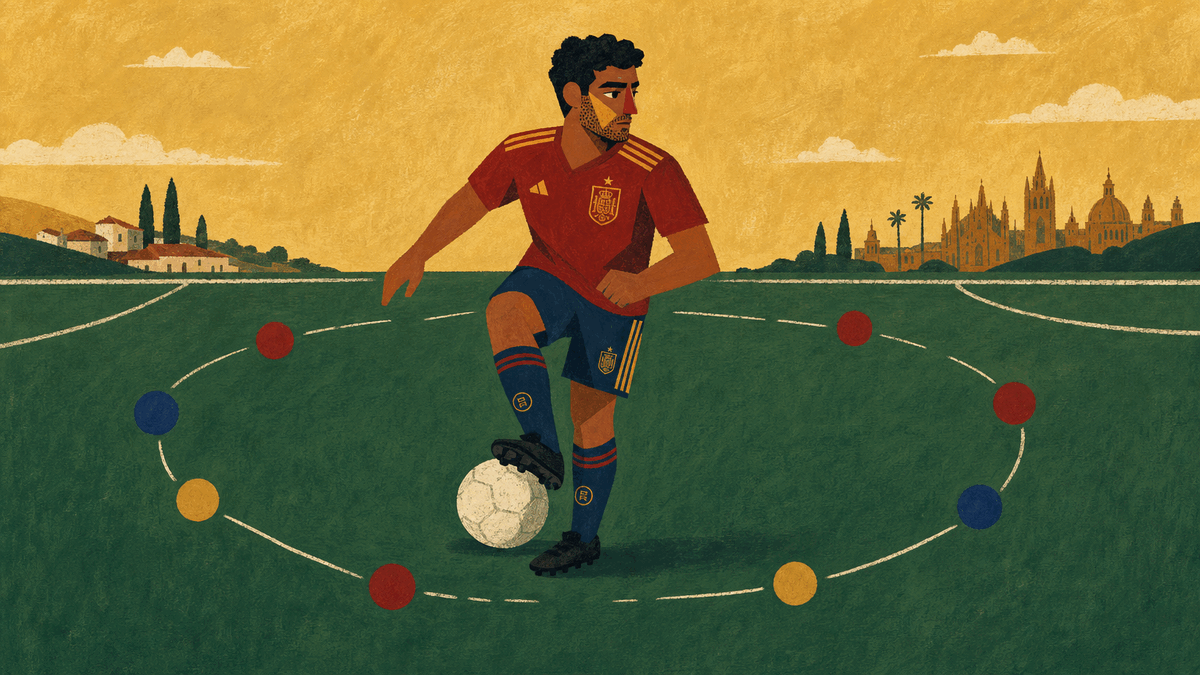
The lineage runs back through the Netherlands. Total Football, the fluid, position-swapping, possession-hungry game, was built at Ajax in the late 1960s under Rinus Michels and carried by Johan Cruyff as a player. When Cruyff returned to Barcelona as manager in 1988, he brought it with him, and the “Dream Team” that won four straight Spanish titles was built on keeping the ball and moving it fast. He is the man usually credited with bringing the rondo, the passing circle with defenders trapped in the middle, into daily training. It is still the first drill most Spanish academies run every morning.
Crucially, Cruyff also shaped La Masia, Barcelona’s residential academy, founded in 1979 on a model he knew from Ajax. The instruction was simple and radical for its time: recruit and keep the clever small player, teach positioning and first touch above all, and do not throw away a gifted fourteen-year-old for being short. Xavi, Iniesta and Busquets are the products everyone names. They are real, and they are only part of the story.
A futsal childhood
Before the academy there is the street, and in Spain the street is often futsal: five a side, a small heavy ball that does not bounce, a hard court, no room and no time. It rewards exactly what the Spanish game later asks for, a clean first touch, an early head-up scan, a pass released before the tackle arrives. Xavi, Iniesta and Fàbregas all played it as boys, and it is widely credited, by them and by their coaches, with the close control they later made look ordinary. Treat the specific quotes as folklore unless you can find the primary source, but the pattern is not folklore: a generation raised in tight spaces grew up comfortable in tight spaces.
Then Aragonés threw out the old Spain
For decades Spain had talent and no trophies, and a self-image built on la furia roja, the red fury: fast, physical, direct, forever falling short. Luis Aragonés made the call that changed everything. Accepting that Spain would not out-muscle Germany or Italy, he built Euro 2008 around the smallest, most technical players he had, shielded them with a single holder in Marcos Senna, and told them to keep the ball. Spain won it, beating Germany 1–0 in the final through a Torres run onto a Xavi pass, and ended a 44-year wait. Vicente del Bosque inherited the idea and industrialised it.
Two archetypes, one idea
Look closely at the twelve and they are not twelve of the same player. They split cleanly into two roles the Spanish system needs. The tempo-setters sit deep and decide how fast the game goes: Busquets and, later, Rodri as the classic Spanish No. 6, with Xavi and Xabi Alonso as the metronomes just ahead. The creators play between the lines and decide where the game goes: Iniesta, Silva, Cazorla, Isco, Mata, Pedri, Fàbregas, and Thiago as a hybrid of the two. One group protects the ball, the other unlocks the door.
Tempo-setters (the deep men)
Creators (between the lines)
La Masia (Barcelona)formed elsewhereFive of the twelve came through Barcelona’s academy (Fàbregas left for Arsenal at sixteen, before a senior game). The other seven were formed at six different clubs, from Oviedo to Las Palmas. The style is national, not one address.
The figure makes the real point, the one the poster skips. Only five of the twelve came through La Masia, and one of those, Fàbregas, left for Arsenal at sixteen without a Barcelona first-team game. The other seven were formed somewhere else entirely: Silva and Isco at Valencia, Cazorla at Real Oviedo, Xabi Alonso at Real Sociedad, Mata at Real Madrid, Pedri at Las Palmas, Rodri at Atlético Madrid. Six clubs, one recognisable player. That is the tell. “Unlike anyone else” is not a Barcelona secret, it is a national coaching culture producing the same profile from a dozen different starting points.
What it actually won
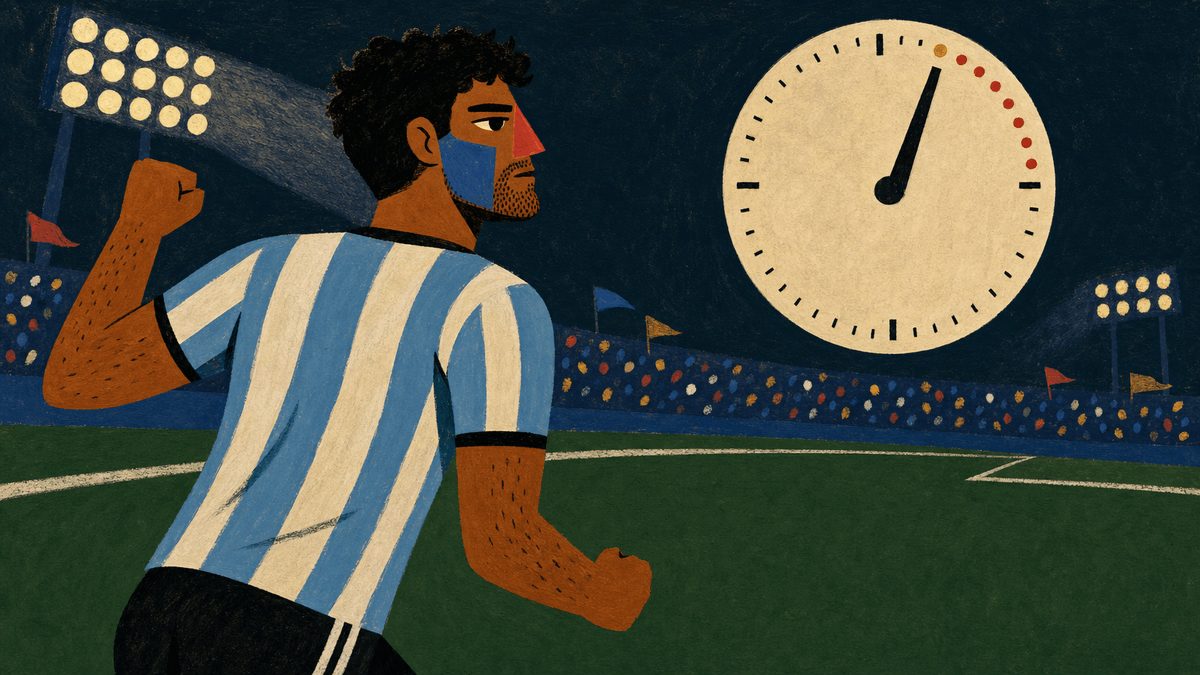
The method has the rarest receipt in international football. Euro 2008, the 2010 World Cup and Euro 2012, three major tournaments in a row, which no other nation has ever done. The 2010 final was the purest expression of it: Spain beat the Netherlands 1–0 after extra time, Iniesta scoring in the 116th minute, the latest match-winning goal in a World Cup final. They did it with control, not chaos. Spain had 57% of the ball in that final, and Xavi finished the tournament with a then-record 599 completed passes at 91.2%, hitting 90 of 97 in the final itself. Euro 2012 was the flourish: 4–0 against Italy, the most emphatic major-final win there is.
Spain did not produce beautiful midfielders and hope. It built a machine for keeping the ball, then won everything by refusing to give it back.
The years it stopped working
No honest account skips 2014. Spain went to Brazil as world and European champions and were gone after two games, dismantled 5–1 by the same Netherlands they had beaten in the last final, then beaten by Chile. The first holders to fall at the group stage like that. The fashionable word turned on them: tiki-taka, coined half in jest by the commentator Andrés Montes around 2006, curdled into an insult for possession without purpose, sideways and backwards and nowhere. Opponents had decoded a system that had stopped evolving. 2018 was the quieter version of the same problem: 1,000-plus passes against Russia in the last sixteen, no cutting edge, out on penalties. Even Guardiola, the style’s supposed high priest, had by then disowned the label, saying he loathed “passing for the sake of it”. Possession was always meant to be a means. For a few years Spain forgot that.
The second wave
The interesting thing about a pipeline is that it keeps running. A new generation arrived without the baggage: Rodri as the best holding midfielder in the world, Pedri wearing Iniesta’s old No. 8 and playing a little like him. The trophies came back. The 2023 Nations League, edged past Croatia on penalties. Euro 2024, seven wins from seven, a 2–1 defeat of England in the final, and Rodri named player of the tournament before winning the 2024 Ballon d’Or. And then the 2026 World Cup, settled 1–0 against Argentina in extra time. Same idea, faster and more direct, less in love with the ball for its own sake. The method learned its lesson.
So, unlike anyone else?
The fair answer is: it was, and now it is the thing everyone copies. Put Spain next to the other footballing cultures and the shape of the claim gets clearer.
- 1
The Netherlands were the ancestor, not the rival
Total Football came first, in the 1970s, and Spain is in large part what happened when Cruyff carried it south and gave it thirty years and an academy to mature in. The pupil outlasted the teacher.
- 2
Germany rebuilt deliberately, and differently
After group-stage humiliations around 2000 and 2004, Germany made academies mandatory for a licence and spent hundreds of millions on youth centres. It produced a golden 2014, but engineered breadth and athleticism, not one signature midfield type.
- 3
England kept missing the deep playmaker
English football long prized the box-to-box runner and the ball-winner over the sit-deep-and-dictate passer. The position Spain mass-produces, Busquets to Rodri, is the one England spent two decades unable to grow at home.
So the poster is right in spirit and dated in fact. For a while Spain genuinely did produce a midfielder no one else could, because no one else had built the culture to make one. Then Guardiola exported positional play to Manchester and Munich and half of Europe learned the grammar. The edge narrowed. What has not changed is the depth: a country that can lose Xavi, Iniesta, Busquets and Alonso and simply hand the same shirt to Rodri and Pedri is not lucky. It is a factory, and it is still running.
In this piece