late goals
Argentina keep winning late. Is that a skill?
Argentina scored again and again after the 75th minute on the way to the 2026 final. Some of that is a real, repeatable edge. Some of it is what variance looks like from the inside. Here is how to tell them apart.
22 July 2026 · 8 min read · James Frewin
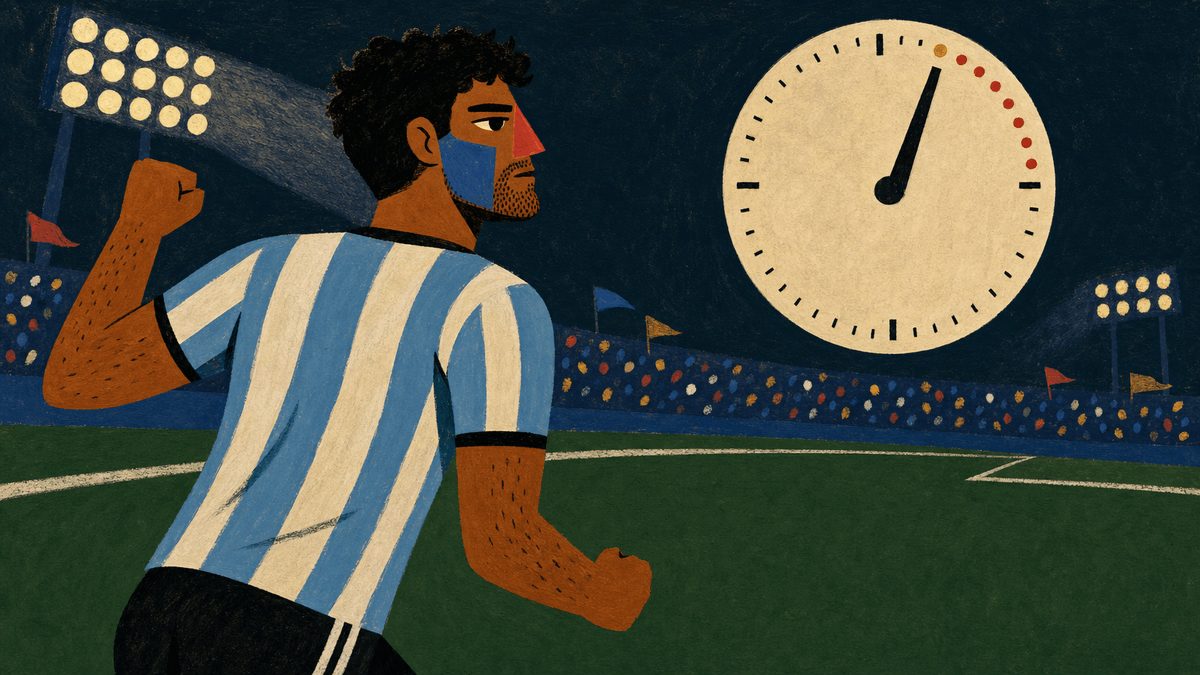
Argentina spent the 2026 World Cup scoring goals at the exact moment other teams stop believing. Two down to Egypt, then three after the 79th minute. Level with Switzerland into extra time, then two more. A goal down to England in the semi, then Enzo Fernández on 85 and Lautaro in stoppage time. Reported counts put them at eleven or twelve goals after the 75th minute, the most by any team at a single World Cup. Scaloni called it “part of our blood.” The question worth asking is colder than that: is winning late a thing you can do on purpose, or a thing that happens to you?
First, the late window is real
Start with what is not in dispute. The end of a football match is where goals live. Opta puts almost 19% of all goals in the final 10 minutes, the single most productive ten-minute window of a game. In the 2025-26 Premier League, 13.2% of goals came in the 90th minute or later, a record, roughly one every 2.9 matches, and those late goals turned a draw into a win 41.7% of the time. So a team that specialises in the last twenty minutes is not fishing in an empty pond. It is fishing where the fish are.
And some of the edge is repeatable
Better still for the “it’s a skill” case, there are structural reasons the late window has grown, and reasons a particular team can exploit it more than most.
- 1
Five substitutes, deeper benches
The five-sub rule, temporary from 2020 and permanent from 2021, lets a strong squad throw fresh, high-quality attackers at tired defenders in the last half hour. Depth becomes a late-game weapon in a way three subs never allowed.
- 2
Longer stoppage time
Since Qatar 2022, referees add far more time: an average of 11.6 minutes there, up 59% on 2018. More minutes actually played is, mechanically, more chances to score after the 90th. The window Argentina keep scoring in is simply bigger than it used to be.
- 3
Fitness and a chaser's aggression
A side built to press and run late, that commits bodies forward when chasing a game, will manufacture more late chances. Game state does a lot of the work: the losing team attacks, the leading team retreats, and the clock rewards the braver one.
All of that is genuine. A team can be built to harvest late goals, and Argentina, with their bench and with Messi freed to conduct the closing minutes, look exactly like such a team.
But the 'always' is where memory cheats
Here is the other half. The specific story, “this team always delivers in the biggest moments,” is precisely the kind of claim that variance dresses up as destiny. Across sports, the measurable gap between expected and actual performance in high-pressure moments shows no year-to-year persistence. The “clutch gene” keeps failing to show up when you check whether the same players do it again next season. And extreme scoring runs, late or otherwise, regress: a team that scores a freakish share of its goals late in one tournament is not, on the evidence, more likely to keep doing it in the next.
The minute each decisive or dramatic goal arrived in Argentina’s knockout games. Five wins rescued or sealed after the 79th minute, then the final, where the same late swing went against them. 2026 minutes are as reported by match outlets and lightly hedged; the two England goals (85’, 90+2’) match this site’s settled record.
Look at the last row. Argentina rode the late swing five times in three tournaments, and then, in the one game that decided everything, it swung the other way: they conceded to Spain early in extra time and lost the final 1–0. Same clock, same late drama, opposite result. That is not a team losing its mentality for one night. It is the coin doing what coins do.
A team can genuinely be built to score late. No team can be built to always score late when it matters. The first is engineering. The second is a story we finish writing after the whistle.
So, skill or luck?
The defensible answer is both, in a specific ratio. The base rateis skill: deep benches, fitness, longer added time and a chaser’s courage genuinely lift how many late goals a good team scores, and a model should give Argentina a real edge in the closing minutes. The streak is mostly luck: the run of decisive, tournament-defining late goals is a cluster, and a cluster is also exactly what randomness produces in a small knockout sample of six or seven games. Believe the mechanism. Distrust the narrative. And notice that the moment you would have most wanted to trust it, the final, is the moment it did not pay.
In this piece