the ground that wasn’t
Casement Park and the stadium that was not built
Belfast was in the winning Euro 2028 bid. Then the money and the calendar stopped agreeing, and a whole nation came off the map. The story of the ground that took Northern Ireland out of its own home tournament.
27 July 2026 · 7 min read · James Frewin
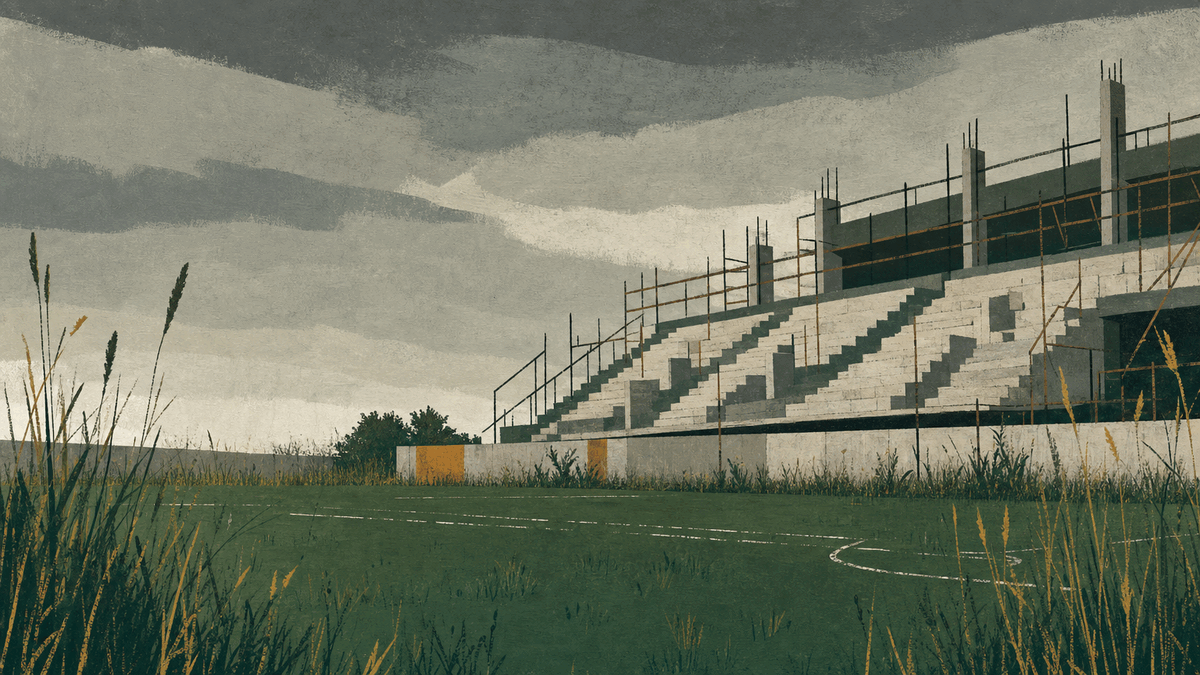
When UEFA awarded Euro 2028 to the UK and Ireland in October 2023, the bid carried ten stadiums. Nine of them were finished, operating grounds you could walk into that weekend. The tenth was a building site that was not yet a building site: Casement Park, a Gaelic Athletic Association ground on the Andersonstown Road in west Belfast, which had not staged a game since 2013 and had already spent a decade stuck in planning, litigation and argument.
Casement was penned in for five matches. It was also the only venue in Northern Ireland in the whole bid, which meant the tournament’s presence in one of the four constituent parts of the host territory rested entirely on one derelict ground being rebuilt in time. It was not. In September 2024 the UK government declined to fund it for the Euros, and Northern Ireland came off the host map altogether.
The ground that stopped being a ground
Casement Park opened in June 1953 and is the home of Antrim’s Gaelic games teams, the principal GAA venue in Ulster. The redevelopment saga long predates the Euros bid, and reading it back is the only way the 2024 decision makes sense. This is the short version, drawn from The Irish News’ timeline of the project.
- 1
1953: the ground opens
Casement Park opens in June 1953 on a site Antrim GAA had acquired through community fundraising, and becomes the county's home for Gaelic football and hurling.
- 2
2013: the gates shut, and the plans stall
The last game is played in 2013. Planning approval for a 38,000-capacity rebuild is granted that year and quashed by the High Court in 2014 after a challenge by a local residents' association. A safety review follows, questioning whether the design could be evacuated in an emergency.
- 3
2017: a smaller design
Ulster GAA submits a new application for a ground of roughly 34,000, materially smaller than the first. Political instability at Stormont then leaves major planning decisions in limbo for years.
- 4
2021: approved, and challenged again
Infrastructure Minister Nichola Mallon approves plans for a capacity of about 34,500. A further legal challenge by the residents' association is dismissed in 2022.
- 5
2023: into the bid
In October, UEFA confirms the UK and Ireland as Euro 2028 hosts, with Casement one of ten venues and five matches allocated to it. The site is still empty. The following month the main contractor withdraws from the project.
The cost line tells the same story in numbers. The original budget was £77.5m. By 2019 it was £110m. During 2024 the then Northern Ireland Secretary, Chris Heaton-Harris, said that when he had promised to find the money the figure was in the “£166 million ball park”. Official estimates later reached around £308m, and the GAA disputed them.
Belfast had one stadium, and it was not ready
The obvious question is why Northern Ireland could not simply move the games. Windsor Park, the national football stadium and Northern Ireland’s home ground, holds around 18,500. UEFA requires a Euro venue to hold more than 30,000. Nothing else in Northern Ireland comes close. Casement was not chosen over a football ground; it was chosen because there was no football ground big enough, and no time to build one.
After the funding decision, the Communities Minister Gordon Lyons of the DUP floated Windsor Park anyway, suggesting that “perhaps an exception could be made”. No exception was made. One ground, one bid, one point of failure.
The money and the calendar
On the evening of Friday 13 September 2024, the Northern Ireland Secretary Hilary Benn and the Culture Secretary Lisa Nandy wrote jointly to Gordon Lyons at Stormont. The UK government would not fund a Casement Park built in time for Euro 2028. Their stated reason was the combination the whole story turns on: the price and the clock.
On price, they said estimated build costs had risen from £180m when the bid was awarded in October 2023 to potentially over £400m. On the clock, they pointed to how little had been built in the intervening period, against UEFA’s requirement that venues be complete a year before the tournament so test events can be staged. Their conclusion was that “there is a significant risk that it would not be built in time”.
The £400m figure is where the accounts diverge, and it has never been reconciled in public. The GAA has consistently rejected it. Ulster GAA’s chief executive Brian McAvoy described the reported costs of £400m plus as “wildly exaggerated”, and in February 2025 the GAA president Jarlath Burns said the association had given the minister a figure including contingencies: “we can build it for around £260 million”. The GAA has also declined to publish its own detailed costing, calling it commercially sensitive, which is precisely why critics say the dispute cannot be settled from the outside.
Two governments, one association and a stadium that nobody could agree the price of.
Blame was assigned in every direction and none of it is settled. Sinn Féin’s Michelle O’Neill, the First Minister, called the decision “deeply disappointing”. Ulster GAA called it “bitterly disappointing” for the GAA and for its partners at the Irish FA. The TUV leader Jim Allister called it “the right decision”. The DUP argued the GAA should be straight about the numbers rather than framing the project as a matter of rights. The Irish News’ own reconstruction spreads the fault across fifteen years: the collapse of the earlier Maze stadium plan, the design and safety problems, the years without functioning devolved government, and the cost spiral that outran every commitment made to it.
The pledges that were on the table remain worth stating plainly, because they are the one part of this nobody disputes. The Stormont Executive had committed £62.5m, the Irish government around £43m (€50m), and the GAA £15m. That was the money in place. It was not close to enough, and no one filled the rest before the deadline mattered.
What the map looks like now
Euro 2028 will be played across nine stadiums in eight cities, from 9 June to 9 July 2028: Wembley and the Tottenham Hotspur Stadium in London, the Etihad in Manchester, St James’ Park in Newcastle, Everton’s new stadium in Liverpool, Villa Park in Birmingham, the Principality Stadium in Cardiff, Hampden Park in Glasgow and the Aviva Stadium in Dublin. Fifty-one matches, the opener in Cardiff, the final at Wembley. Rather than find a tenth venue, UEFA redistributed Casement’s five games across the nine that were left.
The sharper consequence is one most people miss, and it is not about buildings. All four host nations have to go through qualifying like everyone else. As a concession, two places are set aside for the best-ranked host nations who fail to qualify on the pitch. Those two places belong to the hosts, and after September 2024 Northern Ireland is not a host.
So the practical effect of a stadium not being built in Belfast is that Northern Ireland’s footballers lost a safety net they had been counting on. England, Scotland, Wales and the Republic of Ireland can miss out in the groups and still be rescued by ranking. Northern Ireland cannot. They win their group, or take the runners-up route through the play-offs, or they watch. That is a real competitive cost, and it landed on a squad that had nothing to do with the funding argument.
The draw comes to Belfast anyway
In November 2025 the Irish Football Association confirmed that ICC Belfast will host the Euro 2028 qualifying draw on 6 December 2026. The association’s president, Conrad Kirkwood, put it as a positive: “The road to UEFA EURO 2028 starts right here in Belfast.” It is a genuine event, with the coaches and the cameras and the pots. It is also a ceremony for a tournament the city will not stage a minute of.
The ground itself has not gone away. After the Euros plans were dropped the design was revised and the reported cost came down to around £270m for a capacity of roughly 34,500. In the June 2025 spending review the UK government allocated £50m to the rebuild, which Jarlath Burns welcomed while noting the gap that remained. On the figures reported at that point, with the Executive, Dublin, the GAA and the £50m all counted, a shortfall of about £100m was still outstanding. Casement Park may yet be built. It will not be built for this tournament.
Sources
- Euro 2028: Northern Ireland to lose hosting rights over funding · ESPN
- UK govt won't fund Casement Park works in time for Euros · RTÉ, 13 September 2024
- UK government will not fund Casement Park redevelopment in time for Euro 2028 · The Irish Times, 13 September 2024
- Casement Park and Euro 2028: the full story of what went wrong · The Irish News
- Casement Park redevelopment costs 'wildly exaggerated': Ulster GAA chief · The Irish News, 31 December 2024
- Northern Ireland will not qualify for automatic Euro 2028 slot · The Irish News, November 2024
- Burns insists Casement Park can be built for £260m · RTÉ, 11 February 2025
- UK government allocates £50m for Casement Park rebuild · RTÉ, 11 June 2025
- Euro 2028 dates, venues, host cities, format and schedule · Sky Sports
- ICC Belfast named host of UEFA EURO 2028 qualifying draw · Irish Football Association, November 2025
- DUP minister suggests Northern Ireland could host Euro 2028 fixture at Windsor Park · The 42, September 2024
- Stadium history · Casement Park (Ulster GAA)