the regista
Why England still can't grow a Rodri
England went out of another World Cup to a side with a deep-lying playmaker they had no answer to and no equivalent of. The regista is the one midfield type England's game keeps failing to produce. Why the gap persists.
22 July 2026 · 9 min read · James Frewin
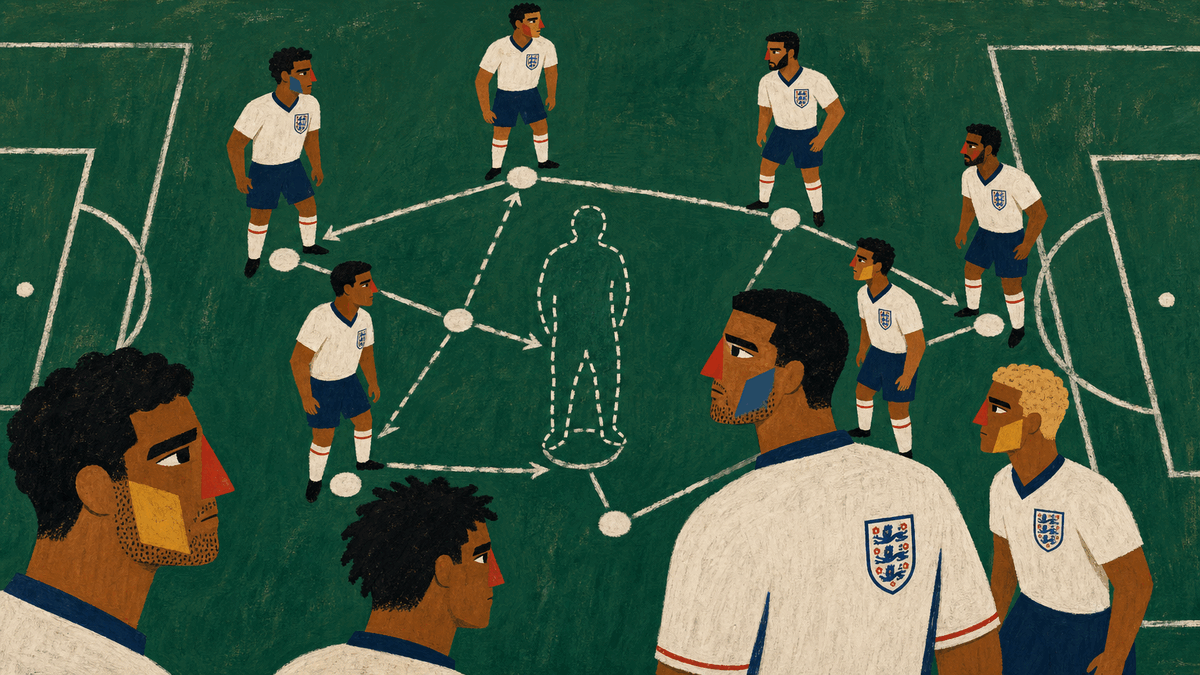
England went out of another World Cup in the semi-final, to an Argentina side that did the damage late, and a familiar complaint followed them off the pitch. Then Spain won the final with Rodri, the reigning Ballon d’Or holder, gliding the game from deep. Graeme Souness put the English problem bluntly: watching Rodri the night after watching England’s midfielders was seeing “arguably the best one in the world at that” next to players who “recycle the ball” but do not hurt you. England do not lack midfielders. They lack a specific one, and they have lacked him for twenty years.
What a regista actually is
The word is Italian for “director,” and the role is exactly that: a player who sits in front of the back line and decides the speed and direction of everything, on intelligence and passing rather than on tackling or running. Coaches’ Voice lists the lineage, Pirlo, Jorginho, Xabi Alonso, Michael Carrick. It is a different job from the two England has always produced in bulk. A box-to-box midfielder is defined by physical presence and covering ground end to end. A ball-winner exists to break play up. The regista does neither. His contribution is concentrated in a narrow zone and is almost entirely about the quality of the decision, not the distance covered.
England's inheritance is the engine, not the director
English midfield greatness has nearly always been physical. The Keane and Vieira archetype, fierce, box-to-box, all heart, is the template English football romanticises. The Gerrard-and-Lampard problem was that England had two goal-scoring, forward-charging midfielders and no one to sit and dictate behind them, which is why the pair never fit together; Lampard himself later said the fix was a deeper third man, a Carrick or a Scholes. And Carrick is the emblem of the whole argument: often called the only recognisable English regista of his generation, and one who, by the common reading, never reached Pirlo’s heights because the “frantic pace of the English game” never gave him the time on the ball the role demands.
The seven players the Premier League used to illustrate the deep-lying No. 6 role in its own explainer. Six are foreign. The one Englishman, Rice, is the exception the rest of this piece is about, and even he is a carrier more than a pure dictator.
The current squad has the same shape
Declan Rice is a genuinely elite midfielder, and it is worth being fair about him: he leads his club for progressive passes and chances created, and does more with the ball than the “just recycles it” caricature allows. But he is an athletic carrier, a No. 6 who progresses play by driving with it, not a still-point who bends a game with his passing range. Rodri outpasses him, around 92% accuracy overall and far more on the long ones, and that gap is the difference between a very good modern holder and a tempo-dictator. Jude Bellingham is a surging No. 8, not a deep director. And the brightest English hope for the pure role, Adam Wharton, tells the story by himself: the closest thing England has to a young regista models his game on Rice.
When the one Englishman who could be your Rodri grows up wanting to be your Declan Rice, the problem is not the player. It is the picture of a midfielder the whole country carries around.
Why the gap persists
The tidy explanation is “England coaches power over brains,” and it is too tidy. The FA’s own development framework, the four-corner model, St George’s Park, the youth-phase “DNA,” is balanced on paper and does not, in writing, prize athleticism over intelligence. The real gap is between that stated philosophy and what the English game actually rewards once a teenager reaches senior football: a Premier League played at a tempo that punishes the player who wants an extra half-second on the ball, and prizes the one who can win it back and carry it. A regista needs time and trust to develop. The English game, at club level, tends to grant neither to a slight, pass-first teenager.
The cost, and the mirror
The result is a recurring tournament story: England assemble as much midfield talent as anyone and keep meeting a side with the one profile they cannot field. Spain have Rodri, and behind him the whole production line that makes his type on purpose. England have the best carriers and ball-winners in the world and a twenty-year hole where the director should be. It is not a talent problem. It is a template problem, and templates are much harder to change than squads.
In this piece