the format, explained
What a 12-group draw does to your nation's chances
Euro 2028 qualifying puts 54 nations into 12 groups and sends 20 of them straight through. That is a generous tournament, and it changes what a hard draw actually costs you. Here is the arithmetic, and where the pain really lands.
27 July 2026 · 8 min read · James Frewin
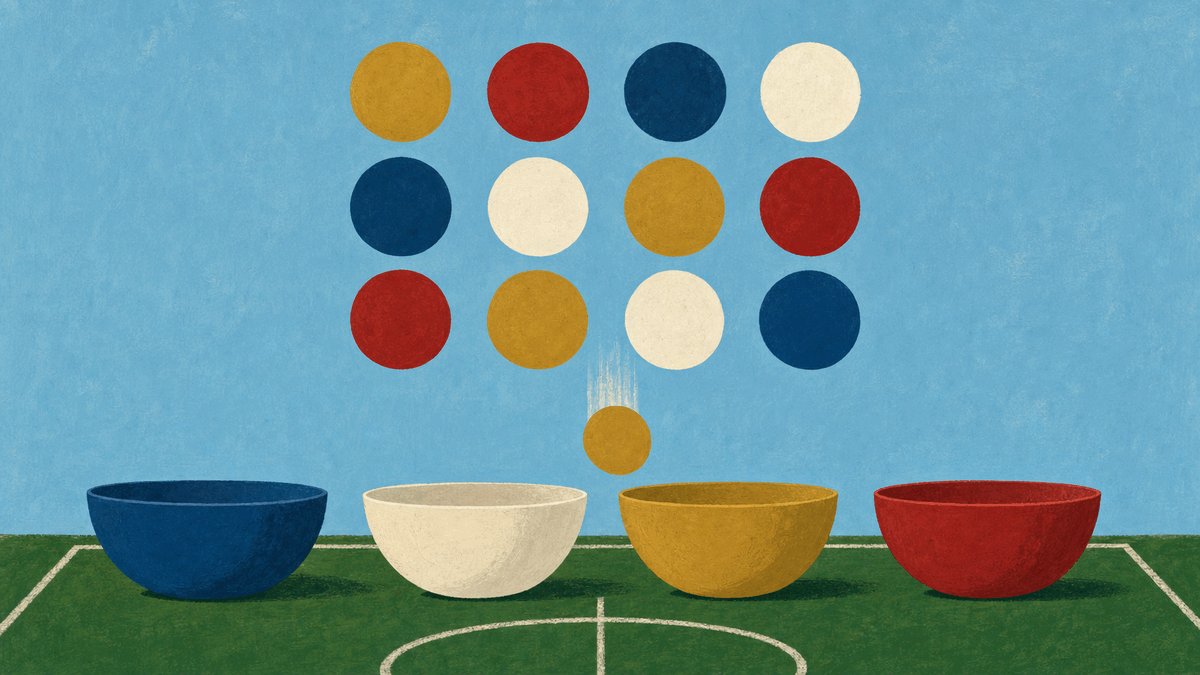
UEFA signed off the qualifying system for Euro 2028 long before anyone knew who would be in it, which is the usual order of things and the reason nobody reads it properly. Fifty-four entrants. Twelve groups. Twenty-four places at the finals. The numbers are simple enough that the interesting question is not what they are, but what they do to a nation’s chances once the balls come out of the pots.
Here is the part most previews skate over. This is a generous tournament. Twenty of the twenty-four places are handed out in the group stage, and there are only fifty-four teams chasing them. That single ratio changes what a hard draw costs you, and it moves the real pain somewhere other than where you would look for it.
The format, in six steps
- 1
The field is 54
UEFA has 55 members and Russia has been suspended, so 54 entrants is the working assumption rather than gospel. All four host nations (England, Scotland, Wales and the Republic of Ireland) enter and have to qualify like everyone else. They are drawn into separate groups, so no group contains two of them.
- 2
Twelve groups, two sizes
Six groups of five and six groups of four is how 54 divides. Teams are seeded into pots by ranking, and the usual shape is one team per pot per group, so the strongest sides are kept apart and the weakest are spread out.
- 3
Home and away, three points a win
A standard double round robin. A group of five plays eight matches, a group of four plays six. That difference sounds trivial and turns out to be the fiddliest part of the whole format.
- 4
Twelve winners and eight runners-up go through
Win your group and you are at the finals. Finish second and you are still in good shape: the 8 best of the 12 runners-up qualify directly too. Between them that is 20 of the 24 places, settled without a play-off.
- 5
Two places held back for hosts
Two places are reserved for the two best-ranked host nations who did not make those 20. Exactly two, no more. If three or four hosts fall short, the net cannot cover them all and the uncovered ones drop into the play-offs.
- 6
The remainder goes to play-offs
Whatever is left, between two and four places, is decided by play-offs between the runners-up who missed the top eight and the best-ranked 2026–27 Nations League group winners who have not already qualified.
That is the whole machine, and it is worth reading from the primary source rather than from a graphic: UEFA’s approved qualification system sets out the places and the reserved host slots, and Sky Sports has the clearest write-up of the play-off shapes.
Twenty places out of fifty-four
Start with the ratio, because everything else follows from it. Twenty direct places against fifty-four entrants is 37%. Nearly two in five teams that enter are at the finals before a single play-off is played, and the play-offs then hand out more.
Qualification, in other words, is not the scarce good here. Something like half the field has no realistic route in whatever the draw does, and near the top of the seeding a good side has to actively go wrong to miss. What is scarce is the group win, and that is the thing a hard draw actually takes off you.
A hard group mostly costs you first place. Second place is very often enough.
What a hard draw actually costs you
Say you are drawn with Spain. The obvious reading is that your campaign just got much harder. The arithmetic says it got slightly harder. You have almost certainly lost the group, but eight of the twelve second places convert straight into a finals ticket, and the four runners-up who miss that cut drop into a play-off rather than out of the competition. Being paired with one of the very best sides in Europe typically moves a good team one route down, not off the board.
The draw bites properly in the middle of the field. Two strong sides in the same group is the dangerous pattern, because then a genuine contender is fighting for second rather than inheriting it, and second is now graded against the other eleven runners-up rather than being safe on its own terms. Get squeezed into third and you have nothing: third place is not a qualifying position, and it is not a play-off position either unless the Nations League has already caught you.
So the honest summary is that the draw matters most for teams ranked roughly seventh to twentieth in Europe, and matters least at the two ends. The very best cannot really be hurt by it. The very weakest cannot really be helped.
Group size is the fiddly bit
Comparing twelve runners-up is easy when the groups match. These groups do not. A runner-up from a five-team group has played eight matches; a runner-up from a four-team group has played six. Rank them on raw points and you have quietly rewarded the teams who got an extra opponent to beat.
UEFA’s own answer is to drop the results against the bottom sidein the bigger groups, so every runner-up is judged on the same number of matches against comparable opposition. Touchline’s model does something simpler: it normalises on points per game. That is a modelling choice, not the official rule, and it is worth saying so plainly. The two methods disagree only when a five-team group’s bottom side is unusually strong or unusually weak relative to the other groups’ whipping boys, which is a small effect on a small subset of campaigns. It moves the answer very little. It does move it.
The tail: play-offs and the two reserved places
The last few places are where the format gets genuinely unusual. Two are held for the two best-ranked hosts who did not qualify on merit, and that number is fixed at two whether one host misses or all four do. The play-offs then fill whatever remains, which is why the play-off structure is not known in advance: it depends on how many host places get used.
Sky Sports lists the three shapes. Eight teams in two paths for two places. Twelve teams in three paths for three places. Or eight teams playing four home-and-away ties for four places. Entry comes from the runners-up who missed the direct eight, topped up by the best-ranked 2026–27 Nations League group winners who have not already gone through, which is the mechanism that lets a side qualify without ever finishing in the top two of its group.
Why the model redraws the groups every time
The qualifying draw is on 6 December 2026. Until then nobody knows which nation is in which group, which means anyone publishing group-by-group probabilities is publishing probabilities for a bracket they made up.
There is a better move available, and it is the one useful methodological idea in this piece. If you do not know a structural input, do not assume one. Average over it. Our simulator draws a fresh tournament from the pots on every campaign, plays it out, and then aggregates. Draw luck stops being a hidden assumption and becomes part of the spread in the answer, which is exactly where it belongs. The cost is that we cannot tell you what happens if England get Italy. The benefit is that every number we do publish already contains the possibility that they will.
What it looks like for the hosts
Run 100,000 campaigns at our default assumptions and the generosity of the format shows up immediately in the host numbers. Qualifying on merit, meaning as a group winner or a top-eight runner-up: England 91.5%, Wales 59.0%, Scotland 55.8%, the Republic of Ireland 47.0%. Ireland, the lowest-ranked of the four on our prior, is close to a coin flip to go straight through without needing the safety net at all. That is what twenty places out of fifty-four buys a mid-ranked nation.
Two caveats, stated rather than buried. Those strengths are a documented prior, a tiered log-goals rating we wrote down and can defend, not a published rating system and not a claim about the true order of European football. And a probability is not a forecast of December’s draw or of anything else. If you disagree with where a nation sits, the useful thing is not to argue with the output, it is to move the input and see how far the answer travels.
You can do that here: the Euro 2028 qualifying model lets you drag each host’s strength and rerun the campaign. The structural finding that falls out of the reserved places, and why two of the four hosts are already safe before a ball is kicked, is in the two hosts who cannot miss.