308 goals
The 2026 World Cup scored 308 goals. Most of it is arithmetic.
A record by a distance, and mostly because the tournament grew to 48 teams and 104 matches. The smaller, more interesting number is 2.96 goals a game, the highest rate since 1970.
20 July 2026 · 6 min read · James Frewin
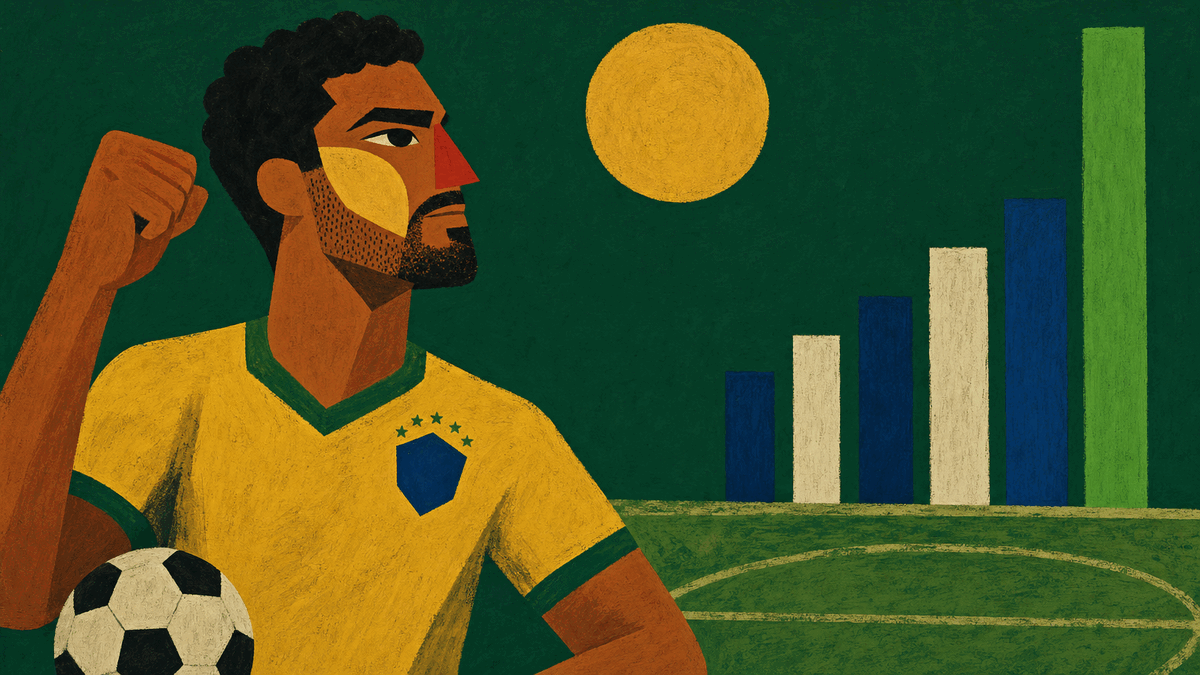
308 goals at the 2026 World Cup, the tallest bar on the chart by a distance and comfortably a record: the previous best was 172, at Qatar 2022. Cue a week of “most goals ever” posts. The number is real. It is also, mostly, arithmetic, and the interesting part is the bit the headline skips.
The record is mostly a bigger tournament
2026 was the first 48-teamWorld Cup: 104 matches, up from 64. That is 62.5% more football before a ball is kicked. Take 2022’s scoring rate, 2.69 goals a game, and run it across 104 matches and you already arrive at roughly 280 goals without anything changing about how teams played. So about 280 of the 308 are simply more games. The record was locked in the day FIFA voted to expand; 172 was never going to survive an extra 40 matches.
But per game, scoring genuinely rose
Strip the format out and the honest figure is goals per game. 308 across 104 works out at about 2.96 a game, and that is the highest rate at any World Cup since 1970 (2.97). The entire 32-team era, 1998 through 2022, never cleared 2.7; the mid-2000s sat down in the low 2.3s. So 2026 was not only a bigger tournament, it was a higher-scoring one minute for minute. Of the 308, roughly 28 are “extra”, above what the expansion alone would have produced.
Rate is each tournament’s total goals divided by matches played. 1954 (5.38) is off this scale on purpose.
Four things pushed the rate up
None of these is a controlled experiment, and they overlap. But put together they are enough to move a tournament from 2.7 to 2.96 a game.
- 1
A wider talent gap
Forty-eight teams pulls in more first-timers and more lower-ranked sides. Group stages with bigger mismatches produce more lopsided, high-scoring games. The extra sixteen teams, on average, do not defend like the top thirty-two.
- 2
Fewer dead rubbers
Twelve groups of four, with eight of the twelve third-placed teams advancing, meant far more sides went into their last group game still needing goals. The cautious, nothing-to-play-for match that drags a scoring rate down was rarer.
- 3
The venues
Several 2026 hosts sit at altitude, Mexico City the highest at about 2,240m, where the ball carries further and legs tire faster. Altitude World Cup games have historically run hot for goals.
- 4
Time added on
The long, accurate stoppage times that arrived at Qatar 2022 did not go away. More minutes actually played is, mechanically, more chances to score, and a chunk of tournament goals arrive after the 90th.
High, but not historic
Per game, 1954 is still untouchable: 5.38 a game, 140 goals in just 26 matches, a post-war shootout no modern tournament comes near. The modern floor was Italia 1990, at 2.21. So 2026’s 2.96 is the best in more than fifty years, but it is a spike inside the modern band, not a return to the 1950s.
“Most goals ever” is true and mostly beside the point. “The most goals per game since 1970” is the line worth keeping.
The habit worth stealing
When a number breaks a record, check whether the thing being counted changed. Here it did: the tournament grew by 40 matches and the total dutifully followed. Read the raw 308 and you conclude football is in a scoring boom. Divide by games played and you get the smaller, truer, more useful story, a real but modest uptick to the highest per-game rate in half a century, with a handful of plausible reasons behind it.