the scorers
Who's most likely to score, and by how much
Turn a team's goals into one player's chance of scoring and the answer is humbler than the hype: the best striker in the world, in a good fixture, is still odds-against. The sum, and how to read it.
21 July 2026 · 6 min read · James Frewin
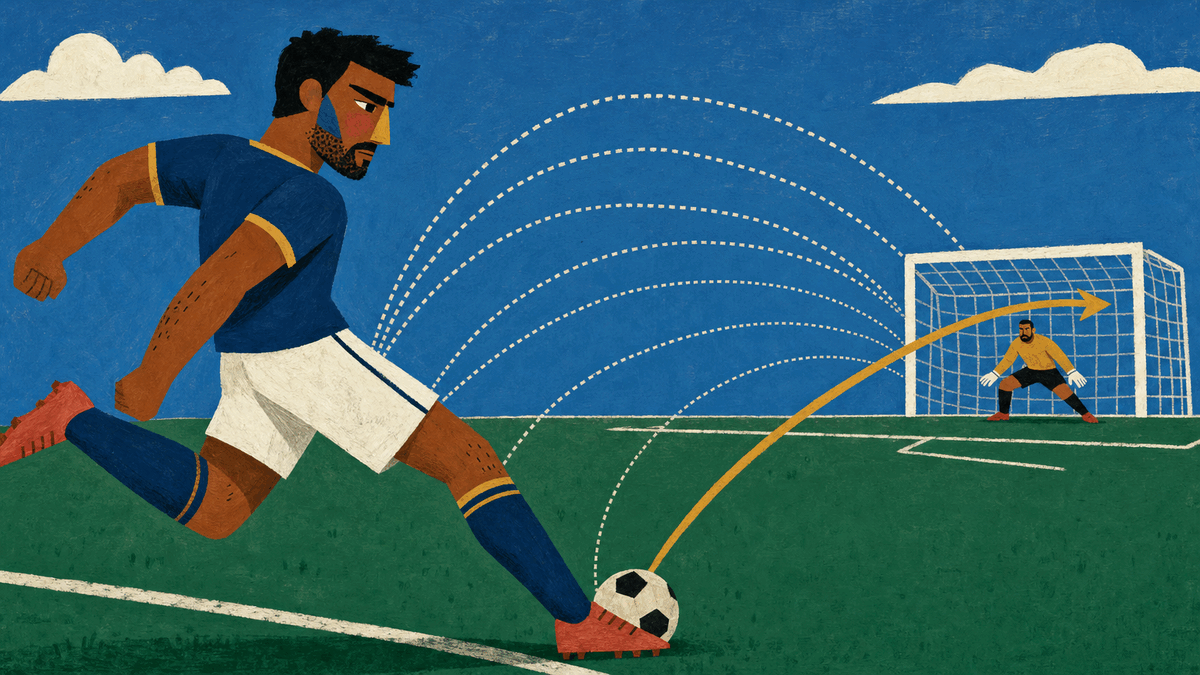
“He’s scoring tonight.” Every group chat has someone who says it with total conviction, and once in a while the game makes them a prophet. The honest version of that sentence is a number, and the number is easy to build: how many goals should the team score, and what share of them does this player take? Two inputs, one multiplication, and an answer that is humbler than the hype.
The sum
Start with the team. A model prices a fixture as expected goals for each side, say 1.6 for a good attack against an ordinary defence. Then ask what fraction of the team’s goals this player usually provides. A main striker might take 30%. Multiply and you have his personal rate for the night: 0.48 of a goal. Goals being rare events, the chance of at least one follows from that rate, and 0.48 works out at roughly 38%.
That is the entire trick behind every “anytime scorer” price you have ever seen. The bookmaker’s number and the model’s number are both built from these two parts: the team’s goals, and the player’s slice of them.
Nobody is ever likely to score
Run the sum for the most feared striker in the world, in form, at home to a struggler, and it tops out around 50%. The best case in football is a coin flip.The ceiling is set by the team, not the player: he can only score if the team scores, and even great teams are held now and then. So “he always scores against us” is not an observation, it is memory doing what memory does, keeping the hits and losing the misses. The number never said likely. It said more likely than anyone else on the pitch, which is a different and much smaller claim.
A 40% chance fails six times in ten. When it lands, that is not the model being right. When it misses, that is not the model being wrong.
What actually moves the number
Three things, in order. The fixture: a softer opponent lifts the whole team’s expected goals, which lifts every attacker’s chance at once. The penalties: spot kicks are converted at a high rate and belong to whoever takes them, so the armband on penalties is worth more than most differences in raw talent. And the minutes: the sum assumes a full game, so a player likely to get an hour carries roughly two-thirds of his full-game chance, and a probable substitute far less. Form, the thing the chat argues about most, moves the number least.
How the engine sets the shares
Touchline’s open-source engine builds scorer weights the same honest way: half from a player’s verified share of his team’s recent goals, half from a prior, so one hot month cannot hijack the number and one quiet month cannot bury a good player. The blend is deliberate. Raw recent form is loud and mostly noise; the prior is slow and mostly signal; the truth sits between them.
Probabilities, not picks
None of this tells you who to back, and it is not meant to. It tells you what the confident voice in the chat is actually claiming, and gives you a defensible number to put next to it. If you want your own call on the record, tag it on a match page and let the leaderboard grade you over a season, the same way the receipts grade the model.