the marginal gains
Set pieces are the new moneyball: what a corner is worth
A corner is worth about three percent of a goal, which sounds like nothing until you count how many a season holds. Why the smart clubs hired set-piece coaches, in numbers.
21 July 2026 · 6 min read · James Frewin
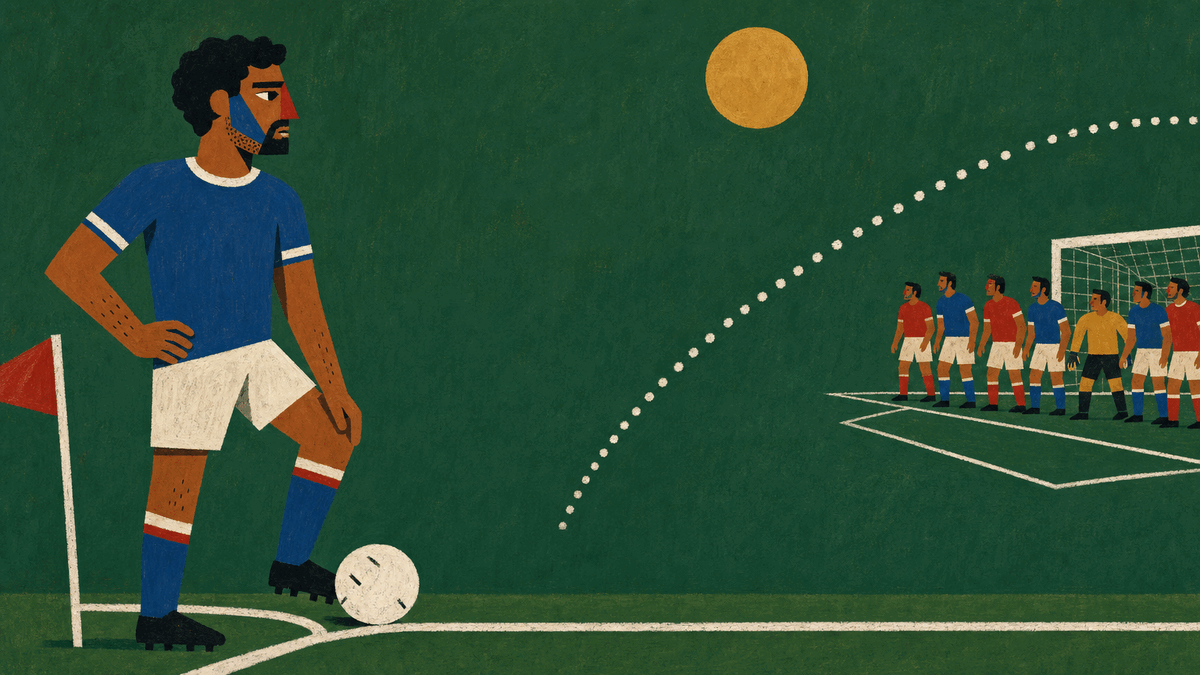
The book Moneyball was never really about baseball. It was about an inefficiency hiding in plain sight: a thing everyone could see but almost nobody valued correctly, until a data-led club started buying it cheap. Football has its own version of that story, and it is not some exotic metric. It is the corner kick, the free kick, the dead ball. The most boring moments in the game turn out to be the most undervalued.
A corner is worth almost nothing
Here is the number that makes people laugh, then think. A single corner is worth only about three percent of a goal. Not thirty. Three. Most corners are headed clear, or drift out for a goal kick, or lead to a half-chance that goes nowhere. Taken one at a time, a corner is a rounding error.
But football is a game of volume. A strong team takes hundreds of corners across a season, wins free kicks in dangerous areas week after week, and steps up for the occasional penalty. Multiply a tiny value by a large, repeated count and you stop laughing. Add corners, free kicks and penalties together and set pieces account for roughly a quarter to a third of all the goals scored in elite football.
Why the dead ball is the inefficiency
The reason set pieces are fertile ground for gains is not that they are valuable. It is that they are repeatable and rehearsable. Open play is chaos: no two counter-attacks are ever quite the same, so there is a limit to how much you can drill them. A corner is the opposite. It starts from a fixed spot, with the ball dead and the players you choose in the positions you choose. It is, in effect, a small set problem you can solve on the training ground and run again on Saturday.
That is exactly the kind of edge a data-led club goes looking for. Not a flashy signing, but a quiet, coachable margin that most rivals leave on the table. For years, most did. Sides practised corners loosely, defended them by habit, and treated the whole category as luck. The clubs that instead treated it as a solvable problem found goals sitting there for the taking.
The value per set piece is small, but it is small, repeatable and coachable, which is the precise recipe for a marginal gain hiding in plain sight.
Enter the set-piece coach
The clearest sign a market has spotted an inefficiency is when it starts paying for it. Brentford were early and notable here, hiring a dedicated set-piece specialist and treating dead balls as a distinct department rather than an afterthought. In the years since, the role has spread across the top of the game, and Arsenal’s heavy set-piece output under a specialist coach has become the widely cited recent example of what a focused programme can add.
The job is unglamorous and specific. A set-piece coach studies opponents on video, designs routines with legal blocks and screens, decides which zones to attack and which runners go where, and drills the defending side of it just as hard. It is the football equivalent of finding a cheap on-base percentage: a repeatable process that produces goals other clubs were not bothering to buy.
How the model sees it
This is where expected goals earns its keep. A set-piece chance is not scored on whether it went in, but on how likely a shot from that position and situation was to be scored, averaged over thousands of similar shots. A near-post flick from a corner and a penalty are both dead-ball chances, but xG values them completely differently, roughly a tenth of a goal against about three-quarters of one, because the underlying odds are nothing alike.
That is what lets you separate a good routine from a lucky one. A team can score a scruffy set-piece goal and still be creating little; another can generate a steady stream of high-value dead-ball chances and be unlucky not to convert. Over a season, the second team is the one to trust. The model does not tell you who wins on the day. It tells you where the repeatable value is, and set pieces are where a surprising amount of it hides.