home edge
Home advantage, measured
A full house is worth something. This is roughly how much, in goals, and why the model nudges the home side before a ball is kicked.
12 July 2026 · 5 min read · James Frewin

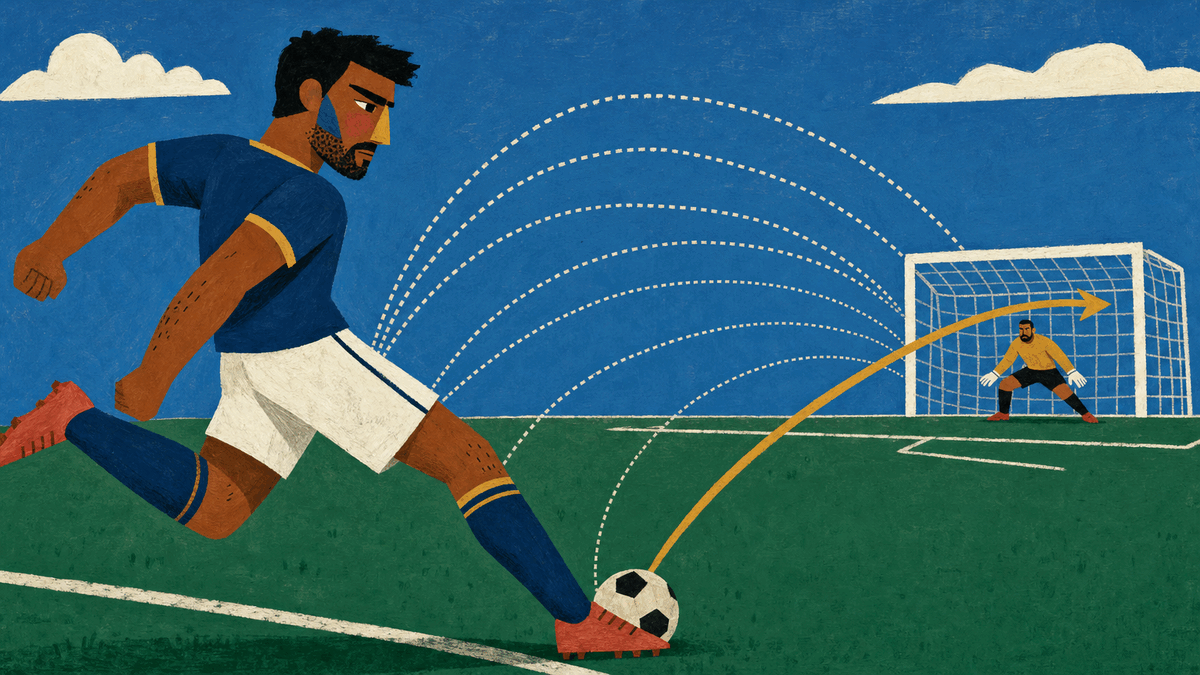
Everyone knows home teams do better. You can feel it in a full ground, and you can see it in the table: over a season, the home side wins more often than the away side, in almost every league anyone has looked at. The interesting question is not whether it is real. It is how much it is worth, in a currency a model can actually spend. That currency is goals, and the answer is smaller, and stranger, than the noise around a big match makes it feel.
Why playing at home helps at all
The usual explanations are unglamorous and they stack. The away side travels, sometimes across time zones, and sleeps in a hotel. The home side knows the pitch, the run-up to the tunnel, the bounce off the advertising boards. A big, loud crowd lifts one team and leans on the other, and there is decent evidence it leans on the referee too: a few more marginal calls, a little added time when the home side is chasing. None of these is large on its own, and you cannot cleanly separate them. What matters for a model is that they point the same way and, added together, they are steady enough to plan around.
The honest caveat is that the size is not a fixed law of the sport. It varies by competition, it is bigger in some leagues than others, and it has drifted down over the years as travel got easier and pitches got more alike. The empty-stadium football of the early 2020s was a natural experiment, and home advantage shrank without a crowd, without vanishing. So the direction is safe. The exact number is a range, not a constant, and it is worth saying so out loud.
Putting a number on it
When people try to price it in goals, the figure is commonly put at a few tenths of a goal to the home side. A third of a goal, give or take, is a good working guess for a typical league fixture. That sounds like almost nothing, and in a sport where a whole match might finish two goals to one, it is not: a third of a goal is a meaningful slice of the entire scoreline. Small inputs move big outputs when the outputs are rare events, and football goals are rare events.
That is the whole mechanism, and it is easier to see than to describe. Start with two teams that are genuinely level, both expected to score the same, and the match is a coin flip with a fat draw in the middle. Then add the nudge to the home side and only the home side. Watch where the probability goes.
A few tenths of a goal, roughly where football is commonly put, tilts it clearly: home 45.8%, away 30.6%. That 15-point gap turns a coin flip into a home lean.
Drag it to a third of a goal and the coin flip is gone. The home win pulls several points clear of the away win off nothing but the venue, and the draw gives up ground on both sides. Push the dial to the far end and the split gets lopsided fast, which is exactly why a range that looks trivial on paper is not trivial once it lands on a scoreline. The output is doing a lot of work with a small input, because that is what Poisson maths does with rare events.
A fraction of a goal is a rounding error in most things. In football it is the difference between a coin flip and a favourite.
Where the model puts it
Touchline does the plain thing. Before kick-off, it adds a home nudge to the home team’s expected goals, on top of the two sides’ underlying strengths, and then lets everything else follow. The win probability, the draw, the sticky 1–1, the most likely scorelines, none of them are set by hand. They all fall out of the two adjusted goal rates. Nothing downstream needs to know the game is at home. The nudge carries it, and it is baked in before a ball is kicked.
It is deliberately not a big lever. The nudge is a few tenths, sized to a range the game actually supports, and it is smaller for neutral venues and knockout ties where the travelling support can match the hosts. It will not turn a weak side into a favourite. It will turn a genuine coin flip into a lean, which is all it should ever do, because that is all the evidence says it is worth.
See the nudge in a real game
Run Newcastle v Liverpool at St James’ Park and watch home advantage price in.