the drift
Why your team's supercomputer odds keep changing
The number you saw on Monday is not the number on Saturday. Team news, money, and time all move it. Here is what actually shifts a prediction before kick-off.
11 July 2026 · 5 min read · James Frewin
You check your team’s supercomputer odds on Monday and they are 58% to win. You check again on Saturday morning and they are 61%. Nobody got injured, no manager spoke, nothing you can name actually happened. So what moved? The honest answer is that two very different clocks are ticking behind that number, and only one of them is about the football.
The market never stops moving
A betting market is not a forecast. It is a running tally of what people are willing to back, and that tally moves every day whether or not anything has changed. Money comes in from people who watched a highlight reel, from a pundit’s hot take, from a bookmaker balancing its book, from someone who simply likes the shirt. None of that is new information about how the game will go. It is sentiment, and sentiment wanders.
So the price you see is a live crowd, not a fixed truth. It can drift three points in an afternoon and drift them back by evening, tracing a jagged line that never sits still. That is not a flaw in the market. It is what a market is for. But it means the number reacting is not the same as the match changing.
A model should move only when the game does
A model is supposed to answer a narrower question: given what we actually know, how is this match likely to go? The number it produces should change when, and only when, something real about the game changes. A key starter ruled out. A confirmed line-up that is not the one you expected. A keeper rotated, a forecast that flips from dry to wet. Those are events with a footballing reason to shift a probability.
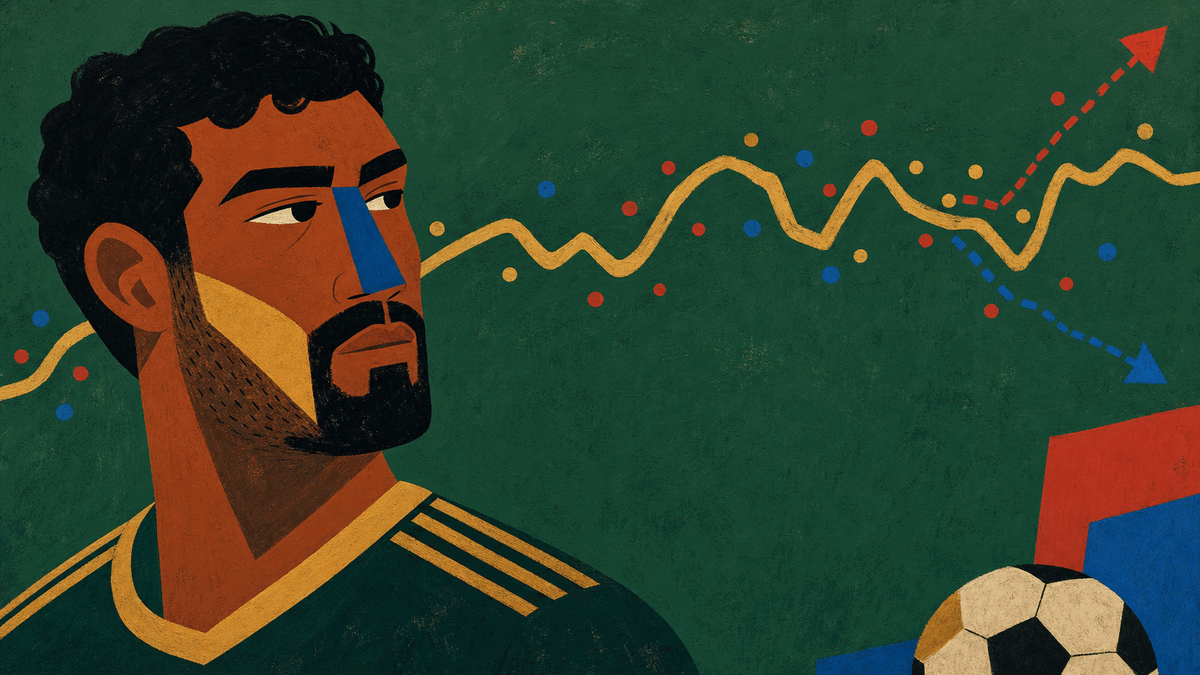
Between those events, the honest thing for a model to do is nothing. If it drifts as much as the market, hour by hour, it has stopped pricing the match and started copying the crowd. The chart below draws the two habits side by side: the market wandering, the model holding flat and stepping only when the news lands.
Illustrative, not live data. The market moves every day on money and sentiment. The model holds its number and only steps when real information lands, then the two meet near kick-off.
The single most informative moment on that timeline is the confirmed team sheet, which arrives about an hour before kick-off. Until then most of the market’s motion is noise, and a model that respects the difference will look boringly still next to it. Then the XI drops, the model takes its one real step, and the two lines finally have a reason to meet.
The market moves with money. The model should move with evidence. Confusing the two is how you end up chasing a number instead of reading a match.
Why this site would rather sit still
That principle is wired into how Touchline runs. Because the site is a static export with no server, the model cannot re-price itself on a whim. Instead an agent wakes on a schedule as kick-off nears and runs a cheap gate first: it reads the free market feed and does a small news scan, then asks one question, has anything material actually happened? A key starter out, a confirmed XI that differs from the modelled one, a market swing that the news can explain.
If the answer is no, it does nothing, commits nothing, and costs pennies. Only when something real has landed does it make the smallest change the evidence justifies: a few points, a sentence of prose, the source added. No full re-run, no rewrite, no chasing a price that moved on its own. Most check-ins are meant to be quiet, and a quiet check-in is the model behaving.
See how the number is built
Read the method behind the model, then run a live match and watch what does and does not move it.